Start the Rhode to Wellness Challenge TODAY! New email went out to subscribers today: Check it out.
RI Public Health Community Unites to Combat Rising Overdoses with Record Narcan Distribution!
![]() |
![]() ![]() |
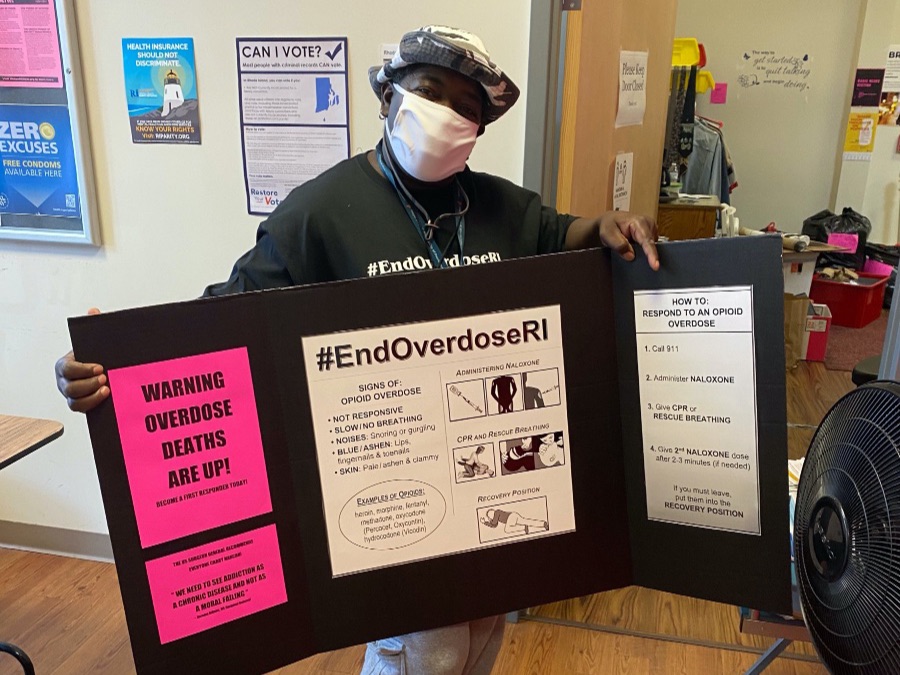
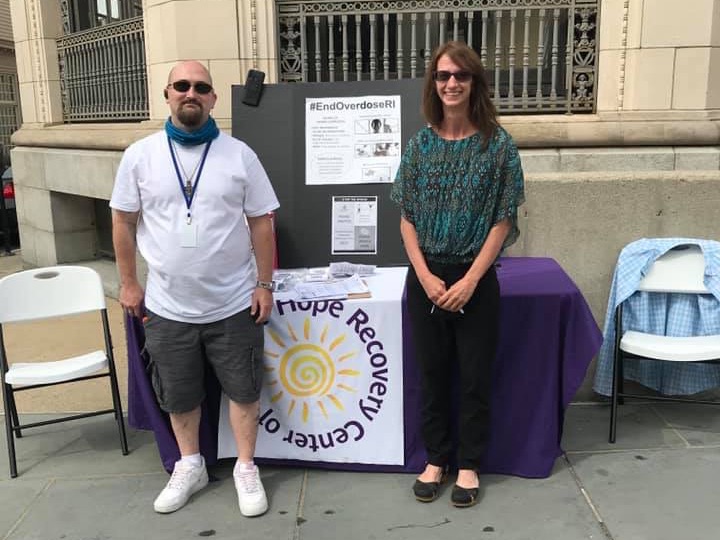
| On August 31st, over 100 volunteers, representing over 16 community partners including RICARES, Parent Support Network, Anchor Recovery, Community Care Alliance, East Bay Recovery Center, AIDS Care Ocean State, House of Hope, VICTA, Sojourner House, Brown University School of Public Health, PONI, West Warwick HEZ, CODAC, URI Community First Responder Program, and Thrive, spread out to 13 cities and towns across Rhode Island to distribute over 1482 Units of Narcan! This event was the brainchild of our very own Ashley Perry, intervention case manager and outreach coordinator for our Providence street outreach efforts. Her efforts as a street outreach worker and as a person in recovery led her to suggest that in addition to our considerable efforts to get Narcan into the hands of those directly using on the streets, it is important to connect with the friends and family members of those using, by meeting them at grocery and liquor stores, laundromats, bike paths, beaches, and barbershops. Ashley said, “The surgeon general recommends everyone carry Naloxone, and we have to be creative about how we get this into the hands of those who might use it to save a life!” Partners and volunteers, all wearing t-shirts with the hashtag “EndOverdoseRI” distributed Narcan and talked to people about overdose prevention and the importance of carrying Narcan, in a year when overdose deaths are sadly expected to break a record. We are very grateful to all of our partners in harm reduction and recovery for collaborating on this life-saving event, and we look forward to next year when we can create something even bigger and more impactful! |
![]() |
September Newsletter
Advocate Child Immunizations! Plus. New email went out to subscribers today: Check it out.

Discussion Draft of the Preliminary Framework for Equitable Allocation of COVID-19 Vaccine
| Public Comment Opportunities Discussion Draft of the Preliminary Framework for Equitable Allocation of COVID-19 Vaccine Public Listening Session Sept. 2 | 12 to 5 pm ET Register Now >>Written Comment Period Sept. 1 – Sept. 4 More Information >> Starting September 1, the National Academies will invite public comments on a Discussion Draft of the Preliminary Framework for Equitable Allocation of COVID-19 Vaccine, part of a study commissioned by NIH and CDC. The study will recommend priorities to inform allocation of a limited initial supply of COVID-19 vaccine, taking into account factors such as racial/ethnic inequities and groups at higher risk due to health status, occupation, or living conditions. Input from the public, especially communities highly impacted by COVID-19, is essential to produce a final report that is objective, balanced, and inclusive.A discussion draft of the preliminary framework will be available September 1. Prepare your comments now to help shape the final report.Register Now! Public Listening Session Wednesday, September 2 | 12:00 to 5:00 pm EDT Please join us for an open session in which members of the public will be invited to address the study committee (as individuals or on behalf of an organization). You can sign up now to make a comment. However, because time at the session will be limited, we cannot guarantee that everyone will have the opportunity to make an oral comment. Please consider submitting a written comment between September 1 and September 4 (more information below).Register Written Comment Period: September 1 – 4 Members of the public are encouraged to submit written comments for consideration by the study committee (as individuals or on behalf of an organization). The public comment period will be open for 4 days, from 12:00 p.m. ET on Tuesday, September 1, until 11:59 p.m. ET on Friday, September 4. Members of the public will be able to download and review the discussion draft before submitting a comment through a form (uploaded documents accepted). All materials comments received will be placed in the committee’s Public Access File, and may be provided to the public upon request. More Information To learn more about the National Academies’ study process, see Frequently Asked Questions on the project webpage.Questions? Email COVIDVaccineFramework@NAS.edu |
Mental Health Resources from NAMI (Online!)
NAMI Connection Recovery Support Groups
– Now over Zoom!!!
NAMI Connection is a free recovery support group for people living with any mental illness. NAMI Connection provides a place that offers respect, understanding, encouragement, and hope. You don’t need to register to attend. For more information about Connections, please call us at 401-331-3060 or email us at info@namirhodeisland.org.
NAMI Connection is a recovery support group program that offers respect, understanding, encouragement and hope. NAMI Connection groups are:
- Free and confidential
- Held weekly for 90 minutes
- Designed to connect, encourage, and support participants using a structured support group model
- Led by trained facilitators living in recovery themselves
Currently NAMI Connections is being held over Zoom. Click here for the latest schedule (updated September 2020).
Advanced Navegante training
Apply here before September 4th!!!

August Newsletter
CHWs ready for certification: CHW Training starts Aug… New email went out to subscribers today: Check it out.

MAKING CONTACT: A TRAINING FOR COVID-19 CONTACT TRACERS
This is a free training
Introductory online course for entry-level COVID-19 contact tracers, for use by health agencies in rapid training of new contact tracers. The training will be augmented by state/local specific training required to orient individuals to jurisdiction-specific protocols. This training focuses on building knowledge for remote contact tracing; a subsequent release will include a module on field services.

Disinfectant Vouchers and PPE Orders
Healthcare practices, agencies, or facilities with 50 or fewer employees can request a disinfectant voucher when ordering PPE through the already-established Rhode Island Department of Health webforms. Most healthcare providers are able to now order surgical masks, face shields, and, if applicable, the disinfectant voucher through www.health.ri.gov/masks. Hospitals, EMS, nursing homes, assisted living communities, home health and hospice agencies, health centers, urgent care centers, and healthcare practices that are serving as respiratory care clinics are able to order PPE from www.health.ri.gov/ppe. Further, SupplyRI has put together a list of local Rhode Island businesses that sell PPE, sanitizing supplies, medical equipment, and cleaning services. If you’re interested in doing business with these companies, you can download the list here.

HHS Announces Partnership with Morehouse School of Medicine to Fight COVID-19 in Racial and Ethnic Minority and Vulnerable Communities
| FOR IMMEDIATE RELEASE Tuesday, June 23, 2020 |
HHS Announces Partnership with Morehouse School of Medicine to Fight COVID-19 in Racial and Ethnic Minority and Vulnerable Communities $40 Million Initiative Will Help Communities Hardest Hit by the Pandemic |
| The U.S. Department of Health and Human Services (HHS) Office of Minority Health (OMH) announced the selection of the Morehouse School of Medicine as the awardee for a new $40 million initiative to fight COVID-19 in racial and ethnic minority, rural and socially vulnerable communities. The Morehouse School of Medicine will enter into a cooperative agreement with OMH to lead the initiative to coordinate a strategic network of national, state, territorial, tribal and local organizations to deliver COVID-19-related information to communities hardest hit by the pandemic. “The Trump Administration has made it a priority to support and empower Americans who have been most impacted by COVID-19, including minority, rural, and socially vulnerable communities,” said HHS Secretary Alex Azar. “This new partnership between the Morehouse School of Medicine and our Office of Minority Health will work with trusted community organizations to bring information on COVID-19 testing, vaccinations, and other services to the Americans who need it.” The initiative – the National Infrastructure for Mitigating the Impact of COVID-19 within Racial and Ethnic Minority Communities (NIMIC) – is a three-year project designed to work with community-based organizations across the nation to deliver education and information on resources to help fight the pandemic. The information network will strengthen efforts to link communities to COVID-19 testing, healthcare and social services and to best share and implement effective response, recovery and resilience strategies. “Underlying social determinants of health and disparate burdens of chronic medical conditions are contributing to worse COVID-19-related outcomes in minority and socially vulnerable communities, and this partnership with Morehouse School of Medicine is essential to improving our overall response,” said Assistant Secretary for Health ADM Brett P. Giroir, M.D. “We’ve made important strides over the past few months in fighting the pandemic, and with Morehouse School of Medicine as our partner, we are ready to advance our efforts to support our most affected communities.” These social determinants of health are the conditions in which we live, work, grow and age, that can include working conditions; unemployment; underemployment; access to essential goods and services such as water, sanitation and food; housing; and access to quality healthcare. Such conditions may reflect inequities experienced by disadvantaged communities, leading to poor health status and adverse health outcomes and requiring community- and systems-level responses. “We know the power of partnerships to help us solve our most pressing public health challenges,” said U.S. Surgeon General VADM Jerome M. Adams, M.D., M.P.H. “This initiative has at its core the community-based organizations who know their people best and who are committed to working collaboratively to reduce health-inequities and make them healthy and safe.” OMH announced the initiative through a funding announcement on May 1. The NIMIC initiative is expected to begin in July and the first award is for $14.6 million. “Communities throughout the country have already done a lot of hard work to adapt and respond to the challenges of the COVID-19 pandemic and its impact on racial and ethnic minority, rural and vulnerable populations,” said Deputy Assistant Secretary for Minority Health RADM Felicia Collins, M.D. “OMH and the Morehouse School of Medicine look forward to continue working with our communities to link them to the information, resources, healthcare and services needed to reduce the spread of COVID-19.” The Office of the Assistant Secretary for Health (OASH), a division of the U.S. Department of Health and Human Services, provides public health and science advice to the Secretary, and oversees the Department’s broad-ranging public health offices, whose missions include minority health, HIV policy, women’s health, disease prevention, human research protections and others. OASH also includes the Office of the Surgeon General and the U.S. Public Health Service Commissioned Corps. The Office of Minority Health (OMH) is dedicated to improving the health of racial and ethnic minority populations through the development of health policies and programs that will help eliminate health disparities. For more information about the Office of Minority Health, visit: www.minorityhealth.hhs.gov/. |
| ###Connect with HHS and sign up for HHS email updates |