Walking Group for Cranston Residents

Walking Group for Cranston Residents!

And a GREAT example of CHWs taking action to meet community needs!  


Announcing, the “Winter Walk & Talk” program in Cranston! Salvatore Nacci, CHW – Older Adults, shares how it got started, “The idea originated within my team here at The OneCranston HEZ. Our Physical Health & Nutrition workgroup had been interested in starting this up and I took it on. It is meant to be a tool for physical activity with a twist of creating a community connection among neighbors and fellow Cranstonians to make friends and discuss their daily lives. It has led to other social activities among the group such as going to Market Basket for lunch or walks around Garden City during the holiday festivities.

We have been doing this for over a year now and have definitely created a bond among us. We usually walk for an hour and a half to two hours 3 days per week,  If you like, come join us for a little walk and talk!” CHWARI is proud to share this news of CHWs doing exactly what they excel at – identifying a health-related need and connecting to resources. What programs can YOU create to meet the needs of YOUR community?  Share them with us!

Contact Sal Nacci with questions. snacci@compcap.org

Federal Medicare to Cover CHW and Peer Support Services!!!!

Big GREAT News for CHWs!

Up until now, some individual states (including RI!) have been setting up their own Medicaid reimbursement for CHW services. Now the federal Centers for Medicare & Medicaid Services (CMS) have finalized policy changes for MediCARE payments effective on or after January 1, 2024 that cover “services involving community health workers, care navigators, and peer support specialists.” This is a game-changer!  

Details are provided on the CMS.gov page: Calendar Year (CY) 2024 Medicare Physician Fee Schedule Final Rule.

From Centers for Medicare & Medicaid Services (CMS):

“Specifically, we are finalizing to pay separately for Community Health Integration, Social Determinants of Health (SDOH) Risk Assessment, and Principal Illness Navigation services to account for resources when clinicians involve certain types of health care support staff such as community health workers, care navigators, and peer support specialists in furnishing medically necessary care. While these types of health care support staff have been able to serve as auxiliary personnel to perform covered services incident to the services of a Medicare-enrolled billing physician or practitioner, the services described by the finalized codes are the first that are specifically designed to describe services involving community health workers, care navigators, and peer support specialists.

NOTE:  This billing will be complex and CHWARI will strive in future months to provide opportunities for learning how to manage the new policy and to make sure CHW voices are heard amidst its roll out. 

CHW Voices for Leadership & Advocacy Group
Speaking of voices, join fellow CHWs on the last Monday of every month to: 
•    Meet other CHWs
•    Contribute to policy discussions
•    Strengthen community connections
•    Join networking groups
•    Keep up to date on CHW news
Next meeting November 27th at 11am.  Learn more here!

Resources for Pregnant People & Substance-Exposed Newborns

This is copied from a Rhode Island Department of Health email sent on June 26, 2023 from communications@notification.health.ri.gov.


June 26, 2023
Resources and Educational Materials to Support Pregnant People Who Use Substances and Substance-Exposed Newborns 
The Rhode Island Department of Health (RIDOH) is working to raise awareness and offer resources to healthcare providers around substance use conditions, particularly as they relate to pregnant and postpartum people and their babies and families. RIDOH wants to ensure that healthcare providers are aware of the impact that various substances can have on their pregnant or postpartum patients and have the resources to support them. Substance use and pregnancy 

Annually in Rhode Island, at least 5% of the approximately 10,000 babies born are exposed to substances that may affect their biopsychosocial health, development, or behavior in the short and/or long term. Substances of exposure can include certain prescribed medications, illicit drugs, alcohol, cannabinoids, and tobacco. 

Resources and supports are available  Parent Support Network of Rhode Island (PSNRI) Through PSNRI’s Healing Mother and Baby Program , pregnant people living with a substance use condition can call or text 401-318-9577 to speak with an English or Spanish-speaking peer recovery coach and access free, confidential help, and support.  

RI MomsPRN This is a free psychiatric telephone consultation resource for healthcare providers who treat pregnant and postpartum people. Healthcare providers can call 401-430-2800 or email RIMomsPRN@CareNE.org Monday through Friday, 8 a.m. to 4 p.m. to be connected to perinatal specialists in real-time.

Family Visiting Program This program provides prenatal support and services [health.us2.list-manage.com] for infants and toddlers, including connecting to other families and available resources. To learn more or get connected, people can call 401-222-5960.

Provider and Patient Education Materials
The following education materials can be ordered free of charge through RIDOH’s Publication Center [health.us2.list-manage.com]: 
Provider guide with background information, screening tools, and referral and supporting resources [health.us2.list-manage.com]
Brochures for display in waiting and/or exam rooms for patients to take with them. Available in Cape Verdean [health.us2.list-manage.com], English [health.us2.list-manage.com], Portuguese [health.us2.list-manage.com], and Spanish [health.us2.list-manage.com]
Palm cards for display in waiting and/or exam rooms for patients to take with them. Available in English [health.us2.list-manage.com] and Spanish [health.us2.list-manage.com]. [health.us2.list-manage.com]
Posters for display in waiting rooms, bathrooms, and each exam room. Available in English [health.us2.list-manage.com] and Spanish [health.us2.list-manage.com]
Safe Sleep flyer to help prenatal providers have conversations with their pregnant patients about ensuring safe sleep practices and environments. Available in English [health.us2.list-manage.com] and Spanish [health.us2.list-manage.com] through RIDOH’s Parents & Caregivers Publication Center [health.us2.list-manage.com].   ORDER MATERIALS NOW [health.us2.list-manage.com]   Contact Margo Katz, RIDOH Substance-Exposed Newborns Program Manager, if you have any questions about these resources.    

Podcast: Public Health Out Loud

Listen to the episode, Healing Mother and Baby: Supporting Pregnant and Parenting People through Recovery [health.us2.list-manage.com].

Guest experts are Katie Gonzalez, a certified peer recovery support specialist supervisor at PSNRI’s Healing Mother and Baby Program [health.us2.list-manage.com], and Margo Katz from the Division of Community Health and Equity at RIDOH. Gonzalez shares her personal story of recovery, as well as some of the success stories she has seen in the Healing Mother and Baby Program.

April 5 Summit Kicks Off RI’s CHW Roadmap Design Project!  

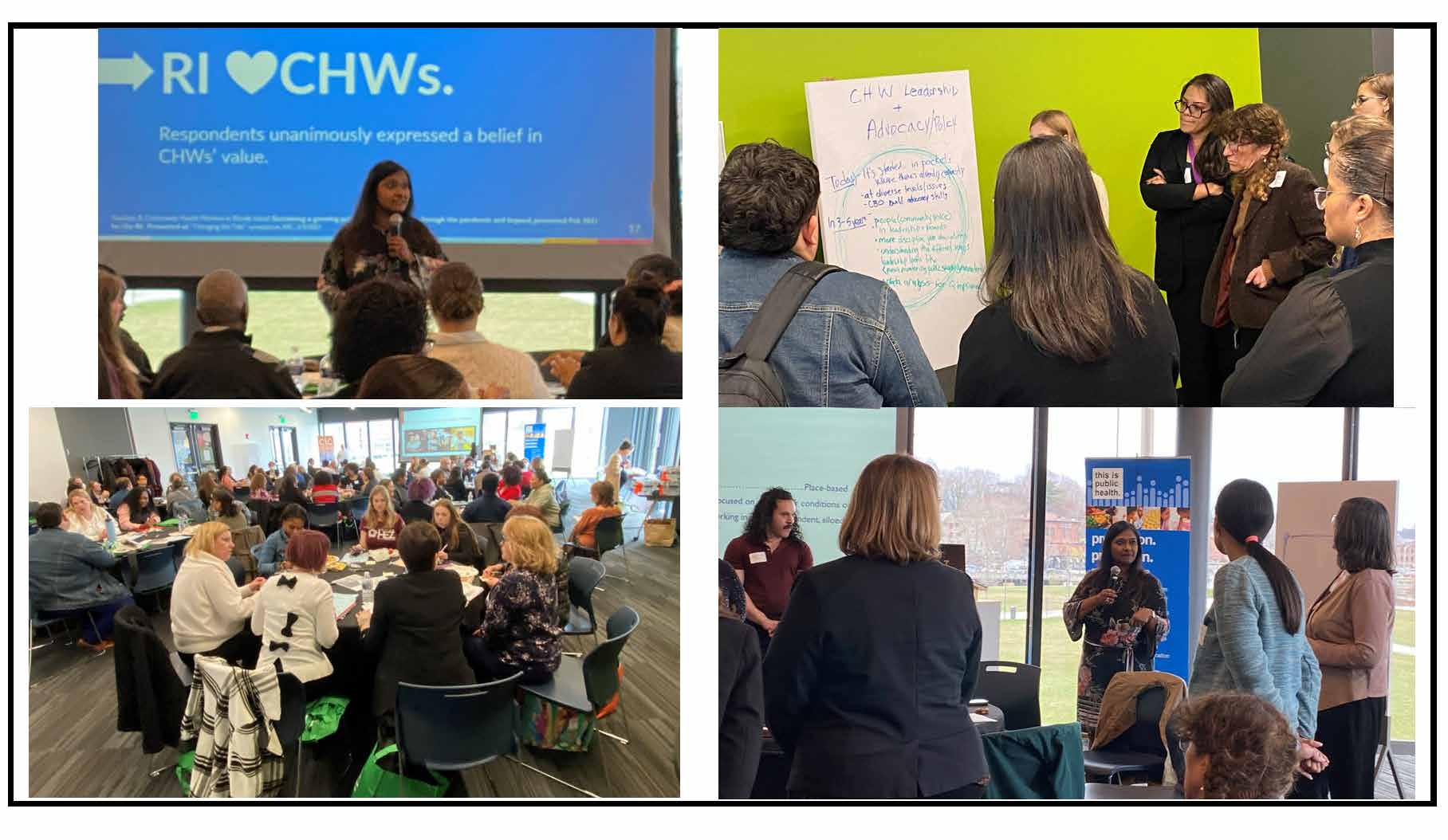
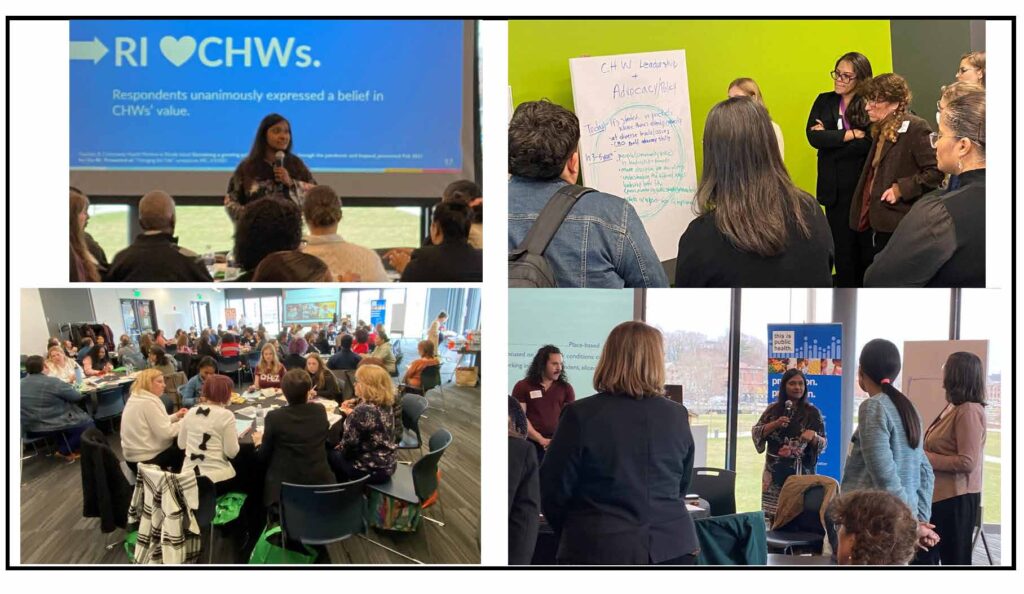
On April 5 at District Hall in Downtown Providence, many CHWs champions and allies came together to collectively envision what’s possible for CHWs in Rhode Island. Of the 91 participants, at least 38 were CHWs! Soma Saha, MD, MS from WE in the World led the activities, with support from the Rhode Island Department of Health and the Care Transformation Collaborative of RI. Many challenging topics were discussed in-depth in large groups and breakout groups over four hours.

Next Steps

This collaborative process will continue over two online Zoom meetings on May 3 (3:30 – 4:30 p.m.) and June 7 (1:30-3 p.m.). 

All CHWs, allies, and policy-makers are invited to participate. All participants from the April 5 CHW Roadmap Summit will automatically receive meeting invitations. (This includes anyone who registered in advance, but was unable to attend.) Members of the RI CHW Strategy Team will also automatically receive meeting invitations.

If you are also interested in attending the next CHW Roadmap Design meetings on May 3 and/or June 7, please email the RIDOH CHW Program at: Geraldine.mcphee.ctr@health.ri.gov.

Thanks to all who participated on April 5!

Providence Vaccination Clinics

Free COVID-19 Bivalent Boosters Offered at Upcoming Community Vaccination Clinics

The Rhode Island Department of Health and Rhode Island schools are offering COVID-19 vaccination clinics to help people get their COVID-19 bivalent boosters. Clinics are open to students and community members. To guarantee an appointment, we recommend registering at the links below.

Vaccines are free. You do not need to have insurance to get your booster dose. If you do have insurance, please bring your card to your appointment. Please note that there are different registration links for people age 5 through 11 and people age 12 or older.

Wednesday, March 22 (3-5 p.m.)
Paul Cuffee Lower School (cafeteria), 459 Promenade St., Providence: 

Tuesday, March 28 (4-6:30 p.m.)
Providence Career and Technical Academy (cafeteria), 41 Fricker St., Providence:

Thursday, March 30 (3-5 p.m.)
Paul Cuffee High School (cafeteria), 544 Elmwood Ave., Providence:

For more information about COVID-19 vaccination and to learn about other COVID-19 vaccination options, please visit c19vaccineri.org or vaccines.gov.

New NIH Structural Racism and Discrimination Funding Opportunity

NIEHS is thrilled to announce our participation in PAR-23-112Addressing the Impact of Structural Racism and Discrimination on Minority Health and Health Disparities. This initiative will support intervention research that addresses structural racism and discrimination (SRD) in order to improve minority health or reduce health disparities.

Please share with your networks!

Please direct inquires to Lindsey Martin (lindsey.martin@nih.gov).

Application Due Dates:

March 24, 2023

October 10, 2023

October 9, 2024

October 9, 2025

NIEHS is interested in applications that are within scope of our 2018-2023 Strategic Plan, that meet the criteria established in this FOA, and focus on intervention research that mitigates or prevents the impacts of environmental exposures on communities due to structural racism and discrimination (SRD). Examples of environmental exposures which are considered of primary interest for NIEHS include but are not limited to: industrial chemicals or manufacturing byproducts, metals, pesticides, herbicides, air pollutants and other inhaled toxicants, particulates, or fibers, fungal, and bacterial or biologically derived toxins. Applicants are strongly encouraged to utilize community engaged research approaches that ensure equity, such as including community partners as part of the research team along with letters of support from community partners. Applications that demonstrate collaborative (i.e., community-academic partnerships) intervention approaches to address the negative health effects of SRD across multiple populations with environmental health disparities will be prioritized. NIEHS is particularly interested in intervention research on a subtype of SRD – environmental racism. For the purposes of this FOA, environmental racism includes the use of racist and discriminatory practices in determining which communities receive health-protective (i.e., green space) or health-harming infrastructure (i.e., industrial complexes). Areas of specific interest to NIEHS include, but are not limited to:

  • Interventions that prevent or mitigate single or combined environmental exposures disproportionately affecting the health of one or more communities impacted by environmental racism
  • Interventions that address the disproportionate health impacts of exposures due to climate change, extreme weather and natural or human caused disasters on communities affected by environmental racism
  • Interventions that prevent or mitigate disproportionate exposures in the built environment (e.g., mold or lead in housing, lack of greenspace) attributed to systemic neighborhood disinvestment
  • Interventions that address the role of environmental racism in occupational exposures
  • Interventions that promote the resiliency of communities experiencing environmental racism

Lactation Consultant Research Survey

CLC to IBCLC Research Survey

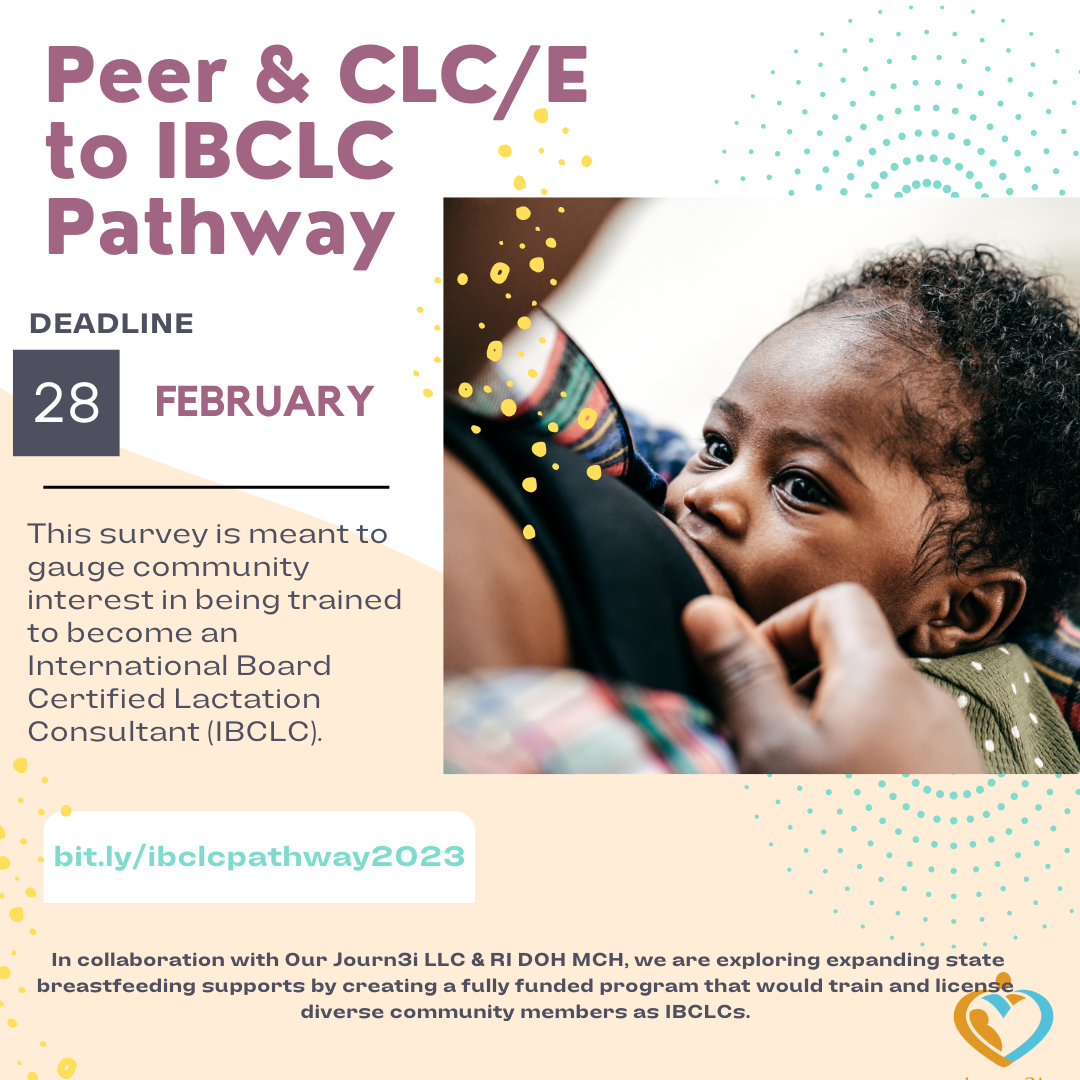
This survey is meant to gauge community interest in being trained to become an International Board Certified Lactation Consultant (IBCLC). In collaboration with Our Journ3i LLC & RI DOH MCH, we are exploring expanding state breastfeeding supports by creating a fully funded program that would train and license diverse community members as IBCLCs. Your input will assist us in the evaluation of the potential expansion of this workforce in RI.

Deadline to complete survey February 28, 2023.

COVID-19 Test Sites Opened in Providence & West Warwick

As Providence, Kent, and Newport Counties are now at a high COVID-19 Community Level, the Rhode Island Department of Health has opened mobile pop-up COVID-19 testing in Providence and West Warwick. You can find the schedule as it is updated here. 

Currently, RIDOH is offering COVID-19 testing at: 

  • Scalabrini Dukcevich Center: 300 Laurel Hill Ave. Providence, RI 02909 
  • South Providence Library: 441 Prairie Ave. Providence, RI 02905 
  • Washington Park Library: 1316 Broad St. Providence, RI 02905 
  • West Warwick Public Library: 1043 Main St. West Warwick, RI 02893 

Please help us share this information in your community. Our Community COVID-19 Testing Event Marketing Toolkit is a supportive resource for helping get the word out.

Testing is located at community-based organizations in ZIP codes that have been identified as high-density communities. Testing at these locations is intended for people in the local community.  

  • Data has shown that residents in these ZIP codes have been disproportionately impacted by COVID-19.
  • By increasing access to fast, free, and effective COVID-19 testing, RIDOH hopes to curb the spread of COVID-19 in these counties while the community levels remain in high.
  • Knowing whether you’re positive for COVID-19 means you can take actions that will help keep you and others out of the hospital, like getting treatment as soon as possible and isolating away from others who may get very sick. If you need help isolating, call RIDOH at 401-222-8022.
  • All of RIDOH’s community testing locations are walk-up (without an appointment) and offer rapid testing only.
  • We continue to work with community partners to identify additional testing locations in Providence and Kent counties.

COVID-19 testing is available at many other locations across the state, like pharmacies, clinics, and doctors’ offices. You can also test yourself for COVID-19 at home. Federal programs are available to support free COVID-19 testing and treatment for people who are sick. 

  • CDC’s Increasing Community Access to Testing (ICATT) program supports free COVID-19 testing for people who have symptoms or have been exposed to someone with COVID-19. To find an ICATT site near you, visit cdc.gov/icatt/AboutICATT.html  
  • Rhode Island also has several Test to Treat sites, where patients can get tested for COVID-19 and, if they’re positive and eligible, get a prescription for treatment all at one location. To find a Test to Treat site near you, visit aspr.hhs.gov/TestToTreat
  • For more information about locations that offer COVID-19 testing services and where you can get free self-tests, visit covid.ri.gov/testing

Resources for partners: 

·       COVID-19 testing event marketing toolkit 

·       Mobile COVID-19 testing schedule and site information 

·       COVID-19 testing information 

·       COVID-19 vaccine and booster information 

·       Test to Treat locator 

Frequently Asked Questions

  1. Where are these test sites located? 

For a list of RIDOH’s mobile COVID-19 test sites, please refer to this spreadsheet. Addresses, site directions, and the nearest Test to Treat site are included in the document.  

Although no one will be turned away from one of these test sites, please know that they are intended for people living in the local community. COVID-19 testing is available at many other locations across the state (refer to question 5 below). For more information, visit covid.ri.gov/testing.  

  1. What type of testing is available at these sites and who is eligible? 

Rapid antigen tests will be used at these test sites. Testing is prioritized for people who have symptoms of COVID-19, but people will not be turned away if they don’t have symptoms.  

Although no one will be turned away from one of these test sites, please know that they are intended for people living in the local community. COVID-19 testing is available at many other locations across the state (refer to question 4 below). For more information, visit covid.ri.gov/testing

  1. Why is RIDOH testing in these communities only? 

Data has shown that residents in these zip codes have been disproportionately impacted by COVID-19. By increasing access to fast, free, and effective COVID-19 testing, RIDOH hopes to curb the spread of COVID-19 in these communities while the county remains in high.  

  1. Will RIDOH reopen State-run test sites like before? 

If all five Rhode Island counties move into the high COVID-19 community level, RIDOH is prepared to temporarily reopen State-run test sites at additional locations throughout the state if needed. These test sites will offer rapid testing by appointment only to Rhode Islanders who have symptoms.  

Right now, Providence County and Kent County remain in the high COVID-19 community level. Bristol, Newport, and Washington counties remain in medium. To monitor Rhode Island’s COVID-19 community levels by county, visit cdc.gov/coronavirus

  1. Where else can people get tested for COVID-19? 

COVID-19 testing is available at many local pharmacies, clinics, and doctors’ offices. Most locations require an appointment, so it’s very important that you call or go online first to schedule your test.  

CDC’s Increasing Community Access to Testing (ICATT) program supports free COVID-19 testing for people who have symptoms or have been exposed to someone with COVID-19. To find an ICATT site near you, visit cdc.gov/icatt. 

Rhode Island also has several Test to Treat sites, where patients can get tested for COVID-19 and, if they’re positive and eligible, get a prescription for treatment all at one location. To find a Test to Treat site near you, visit aspr.hhs.gov/TestToTreat

You can also test yourself for COVID-19 at home. Self-tests are a fast and reliable way to find out if you have COVID-19. Right now, all households are eligible to order four more free COVID-19 self-tests from the federal government. Placing an order online or by phone is free and insurance is not required. To order online, visit COVIDTests.gov. To order by phone, call 1-800-232-0233. 
Current Mental / Behavioral Health Supports

This time of the year can be tough for many. Here are some mental and behavioral health resources available in RI. This list was compiled by one of our awesome CHWs. Some of the information may have changed – but it’s a start!

Some helpful PDFs:

  • What is a Licensed Community Mental Health Center? (And where can I find one?) PDF
  • BIPOC Mental Health Resource List in RI PDF

And some links to resources:

  • FSRI has Emergency Response Services that can help some families.
    • Referral form here: https://www.familyserviceri.org/find-help/ or call intake at 401-519-2280 if you have any questions about the program or their eligibility requirements.
    • They offer same-day in-person services for any children under 18yrs old experiencing mental/behavioral health emergencies. Children’s Mobile Crisis has its own on-call phone number which can be reached at 401-854-6678.
  • Oasis Wellness and Recovery Centers (Facebook page here)
    • Oasis Recovery and Wellness Center provides a wide range of daily peer support activities and trainings to promote recovery from mental illness and to allow members to embrace fulfilling paid or volunteer work in the community.  Phone: (401) 831-6937   Email: info@oasis-ri.org

RI Doula Bill Passes!

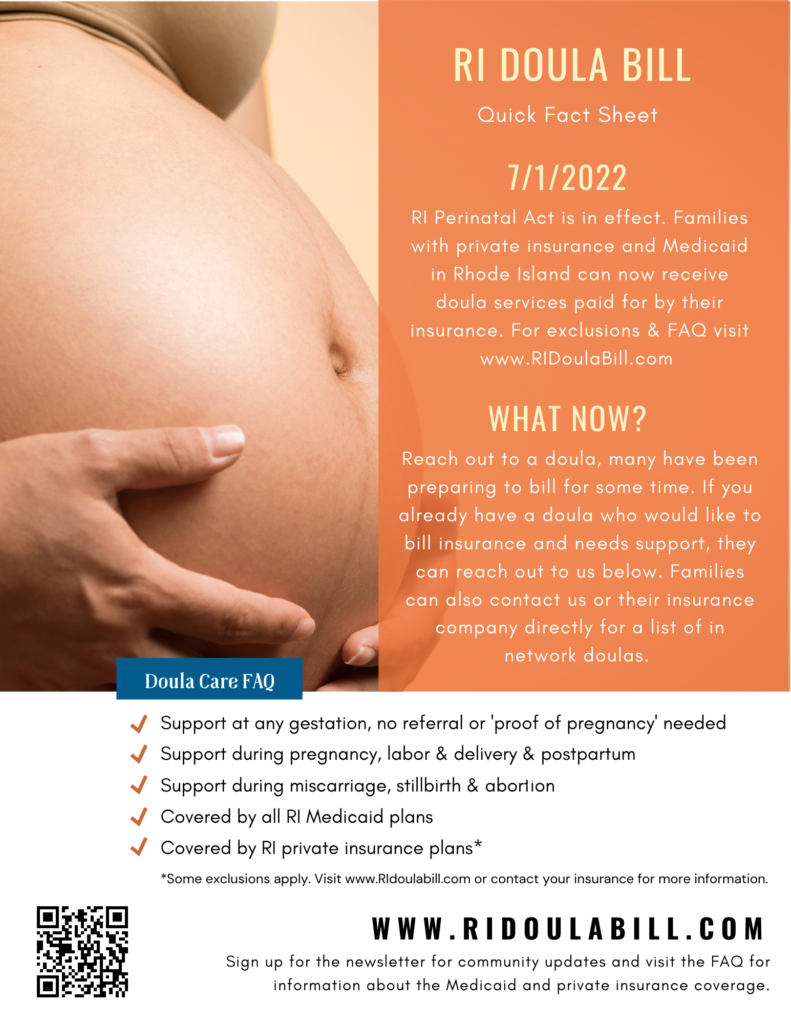
At long last the day is here…. Doula care is OFFICIALLY covered by insurance as of July 1, 2022

This means that nearly all Rhode Islanders can access doula care through their Medicaid or commercial insurance. (Some exclusions apply visit RIdoulabill.com)